


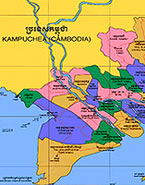


“Nam Tien” and Indochina’s First Genocides against Cham
and Khmer populations
 | |||||||||||
| Traditional Cham dance performed for tourists at Cham Towers in My Son, southern Vietnam |
“It is thought that the majority of Chams were killed, driven off, or assimilated by the Vietnamese. Chams still exist today as an ethnic minority in Vietnam — though its number is relatively small (about 40,000) in comparison to the 30,000 Cham families in the eleventh century.”
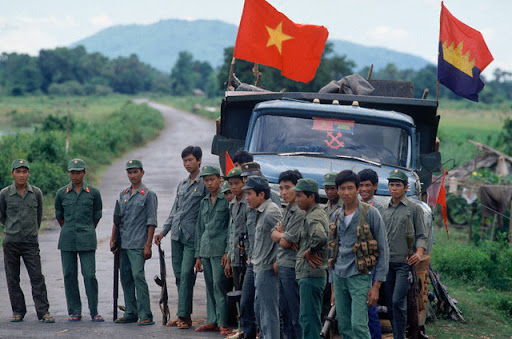 |
| Vietnamese "volunteers" in Cambodia during the 1980s. Military incursions by Dai Viet [Vietnamese State] into neighbouring countries had been a constant thread throughout Vietnamese history. “In the 1978 border war with Cambodia, the new socialist government of Vietnam used the Khmers as an advance column in their invasion into Cambodia.” |
 |
| Crowd-friendly Vietnamese cops armed with batons trying to keep festival goers in line at a traditional Khmer ox race event in Cambodia's former territory of Lower Cambodia [Kampuchea Krom] |
“To be sure, however, the Nguyen’s colonial[ists] did displace the local populations of the Chams and the Khmers, whose “displacement but not replacement” is still today not assured.”
“Like the Chams, the Khmers were also “discredited” of their role in developing the commercial areas near Saigon. Their contribution to the Vietnamese vocabulary and phrases is often overlooked. This is also true regarding their religious practices, which the Vietnamese have adopted, including elements of Theravada Buddhism. Other cultural borrowing from the Khmers includes agricultural implements and foods, medicines, and different areas of arts.”
In Vietnamese history, a theme that transcends across
time and space is the advance or the march to the south (“nam tien”).
The southern advancement, as noted by Michael Cotter, is unique in that “it
transcends the different periods of Vietnamese history – pre-Chinese, Chinese,
independent, colonial, and contemporary” in which each has “its own theme.” [1]
As discussed in earlier blogs, Chinese colonial diasporas
had both indirect and direct effects on the southern advancement.
For Vietnamese, they have been “victims” of Chinese colonial
diasporas — being physically, psychologically, culturally, and intellectually
displaced. However, as noted by other scholars, the “Vietnamese will to [in]dependence
was too strong,” there must have been “a special Vietnamese collective identity
of some sort,” [2] and the “harmony between the Vietnamese . . . and their
environmental conditions has proved to be so deep that no race has been able to
resist their advance.” [3]




0 comments:
Post a Comment